





Is only building quality software solutions enough to attract potential customers?
If your answer is yes, you are wrong and left behind your competitors. No matter how quality-based a software you develop, you will still face difficulties in luring potential customers who will be interested in opting for your services. This is where you need to focus on improving the visibility of your business and opt for SEO for tech companies.
The major role of search engine optimization is to improve the position of your website in search engine result pages (SERPs). And thus maximize its reach among your target customers. It helps your website generate organic traffic and thus gives more opportunities to generate leads.
According to a recent survey, organic traffic drives approximately 53% of overall website traffic. And it’s a fact that a large number of B2B buyers prefer to research with a generic search even before approaching the service provider.
While doing SEO for tech companies, you need to always keep in mind that ranking in Google is now not limited to only basic keyword placement. It requires a powerful strategy for trust, scale, and technical accuracy. Being a tech company, you need to focus on intent-based and value-driven keywords, unlike any other traditional business.
In this post, we will discuss in more detail how technology companies can sketch out a solid SEO strategy to get the desired outcomes. Let’s explore more details:
What is SEO for Tech Companies?
As an integral part of a digital marketing strategy, SEO enhances the online visibility of technology companies. It helps your organization appear at the top of the organic search results, attracts more eyeballs, and thus grabs immense opportunities to convert increased traffic into potential customers.
Search engine optimization is not only limited to keyword selection and its proper placement – it’s also meant to address various unique challenges of SaaS platforms, tech products, complex B2B sales cycles, etc.
To get the wonderful outcomes, professional SEO experts focus on technical excellence, including page speeds, website architecture, scalable content structures, and JavaScript rendering. It also emphasizes extensively targeting users researching solutions, intent-driven keywords, integrations, or comparison instead of high-volume terms.
As far as content is concerned, it plays an indispensable role in determining the success of your SEO efforts. Your content strategy should include product pages, technical blogs, thought leadership, documentation, use cases, and more.
When you do SEO for tech companies by adopting the right approach and impeccable strategies, it helps you lure qualified traffic, develop authority, and boost long-term and sustainable growth.
Why SEO is Important for a Tech Company
According to Backlinko, the website that appears at #1 in search results gets an average CTR of 27.6%. This state clearly reflects the importance of search engine optimization that boosts the position of your website in search results. Apart from improving search engine ranking, SEO is vital for any tech company for many other reasons as well:
- Beat the Growing Competition
It’s a fact that the tech industry is heavily crowded with new solutions, and startups are already making their way to the market regularly. SEO ensures technology companies emerge by enhancing rankings for high-intent search queries.
When your website appears in search results consistently, it helps you gain a competitive edge over rivals who rely mainly on outbound marketing and paid campaigns. With a powerful SEO for tech companies strategy, you can make your brand easily discoverable for those who search actively for the right solutions.
- Boost Brand Visibility
SEO contributes a lot to improving brand visibility across search engines. It helps your website rank for problem-based queries, industry-specific terms, branded, and relevant keywords. And helps your tech company become a top-of-mind throughout the buyer journey completely. Consistency in visibility is something that is quite essential to increase recall, build familiarity, and thus keep your brand as a trusted solution provider.
- Build Trust
The fact can’t be denied that trust has a stronger influence when it comes to tech buying decisions, especially when we talk about high-value and B2B products. When your website ranks well, it will be perceived as authoritative and credible. Search engine optimization is pivotal to building trust with both search engines and users. It has a direct influence on both customer confidence and conversion rates.
- Maximize Product Sale
SEO works effectively and delivers outstanding results when it comes to increasing intent-driven and qualified traffic. It attracts those who already search for the solutions you provide.
All you need to do is align your content with search intent and then optimize product pages to lure prospects who are easy to convert. It causes more demo requests, quality leads, and free trials. These finally boost product sales.
- Cost-effective Promotion
When you compare SEO for tech companies with any other form of marketing campaign, it’s indeed quite affordable. It requires an upfront investment and thus long-term returns that are indeed substantial.
It ensures organic traffic continues to surge without any recurring ad spend, revenue over time, and also delivers consistent leads. SEO yields an improved ROI and thus helps technology companies looking for scalable growth.
How is Tech SEO Different From Traditional SEO?
Tech SEO is completely different from traditional SEO in many aspects. We will explain some of these important aspects by creating a table:
| Points of Differences | Tech SEO | Traditional SEO |
| Target Audience | Its target audience mainly includes developers, B2B buyers, product managers, CTOs, and decision makers. | Its target audience is local or general customers. |
| Keyword Strategy | It focuses mainly on long-tail, intent-driven, and keywords that fall into the category of problem-solving. | It mainly targets generic and high-volume and relevant keywords. |
| Content Type | It includes varieties of relevant content including product documentation, technical blogs, use cases, comparison guides, and whitepapers. | Its content type includes landing pages, blog, promotional content, and service pages. |
| Technical Complexity | It has a high technical complexity, which includes page rendering, site architecture, JavaScript SEO, etc. | It includes a moderate level. The technical complexity includes site architecture and basic on-page SEO. |
| Search Intent | It has a strong focus on commercial and informational intent across the funnel. | It quite often focuses on transactional intent. |
| Content Updates | It requires frequent updates due to rapid changes in technology. | It requires less frequent updates. |
7 Proven SEO Strategies for Tech Companies to Rank Easily
Now, we have explored much about the importance of search engine optimization for technology companies. So, it’s the right time to discuss how to do it better. Let’s explore some of the practical tips and tricks you can consider to implement to get the desired outcomes:
1. Do Keyword Research for Tech Companies
One thing you need to understand is that the result you get from SEO for tech companies is directly related to the keywords you target. So, you need to have a solid keyword strategy that can save you both time and budget.
The first and most important thing you need to do is to start with in-depth research work. Let’s find out some of the top keyword research tools you can leverage:
- Google AutoSuggests: It helps you filter keywords with the use of long-tail phrases.
- SEMrush or Ahrefs: These tools are useful to visualize keyword ideas related to your products or services.
- Google Keyword Planner: It helps you find relevant terms with commercial intent.
- AnswerThePublic: You can use this tool to learn several common and related questions that people ask.
It’s advisable to use a combination of these tools to get a number of keyword ideas that actually work, across commercial, information, and bottom-funnel intent. Once you find a complete list of queries, you need to start creating topic clusters.
The cluster helps you match different types of intent, organize complex topics, and boost topical authority. You need to consider it as a core hub that includes a certain topic and smaller pieces that go into detail.
- Discover Easy-to-Rank Opportunities
When you use competitive terms, they take more time to rank. So, the most important thing you can do is to look for those terms that only a few businesses target. These phrases are indeed easy to rank, more specific, and bring qualified leads.
It’s advisable to find less competitive keywords with the use of these tools from your earlier steps. You can initiate the process by typing seed terms and then sorting the list with low difficulty stores. After this, you can scale for phrases that relate closely to your business.
- Focus on Comparison Keywords
When it comes to comparison keywords, they are used by people who are already in the buying process but have yet to decide on the vendor. The actual value of these important keywords in search engine optimization for IT is in the intent.
If someone wishes to use comparison keywords, they actually look for reasons to select one over the other. These are basically the types of keywords that have the capability of bringing in motivated visitors who are all set to book a demo or take your name to the meeting of stakeholders. To find the right keywords, you can do the following important things:
- You just need to type your service or product into Google and add either “best for”, “alternatives”, or “vs”.
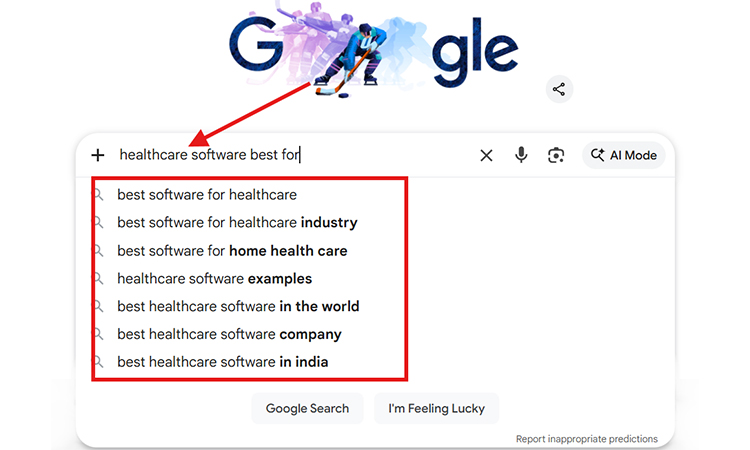
So, above you can see the suggested result based on our inputs. You can also use tools like SEMrush or Ahrefs to filter for modifiers.
2. On-Page Optimization
On-page SEO for tech companies is a process that reflects the optimization of various elements within your website. It boosts both user experience and search visibility. A powerful on-page SEO is quite essential for technology companies that operate in highly competitive markets. It ensures your solution pages, product pages, blogs, and documentation are easy to discover and align better with search intent.
The following are some of the top on-page elements you need to consider to implement:
- Title Tags and Meta Descriptions
Both title tags and meta descriptions play a vital role in attracting users and thus increase traffic to your website. Meta titles and descriptions appear in search results. These are the first things users come across. So, you need to communicate value clearly for a large number of technology companies, be it for an API service, SaaS solution, or enterprise software.
After going through the importance of meta titles and descriptions, you may be keen to understand how to write the same. You can write and make them compelling by implementing the following important practices:
- Make sure your meta title is within 60 characters.
- Write meta descriptions within 155 to 160 characters.
- You need to include your primary keyword in both the title and description.
- Add certain value-based words such as enterprise-ready, free-demo, etc.
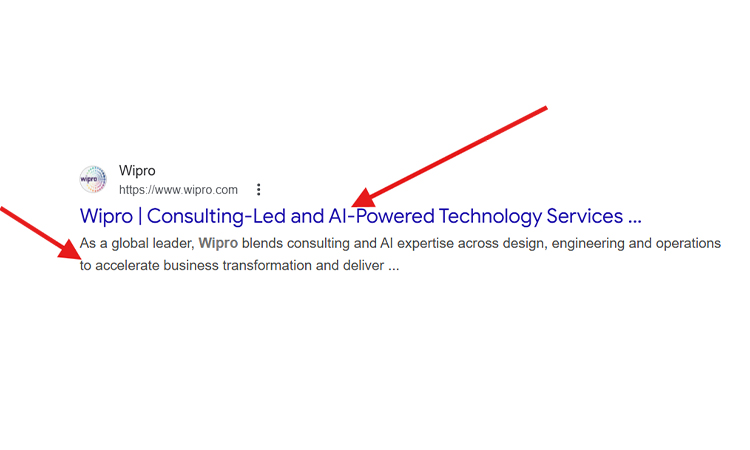
In the above image, you can clearly visualize the use of the keyword “AI-powered technology services”.
- Header Tags
Structured headers are necessary to let search engines understand your content structure and hierarchy. Headers work effectively when it comes to improving crawlability and reusability for tech websites.
Important Practices to Implement
You can implement the following crucial practices to improve the structure of your content and use it appropriately for search engines:
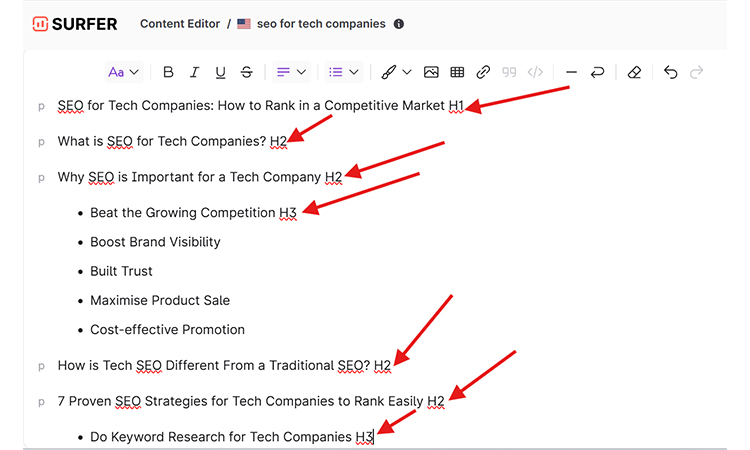
- H1: It should be your title or heading with your primary keyword. H1 will be used only one time in your content.
- H2: It will be used in subheadings. You can use it multiple times in your content.
- H3: You can use it for subpoints in your content
- Always avoid keyword stuffing in your content.
- URL Structure
Make sure your website has keyword-based and a clean, search engine-friendly URL. It’s necessary to boost indexing and usability. Many technology companies often prefer to craft parameter-based and long URLs, which is indeed a wrong practice. If you also do the same, you need to avoid it as it impacts clarity.
Important Practices to Implement for the Right URL
- Avoid using underscores Instead, you can use hyphens.
- You need to make your URL short yet descriptive.
- Include primary keyword
- Avoid unnecessary parameters
- Always maintain a logical folder structure.
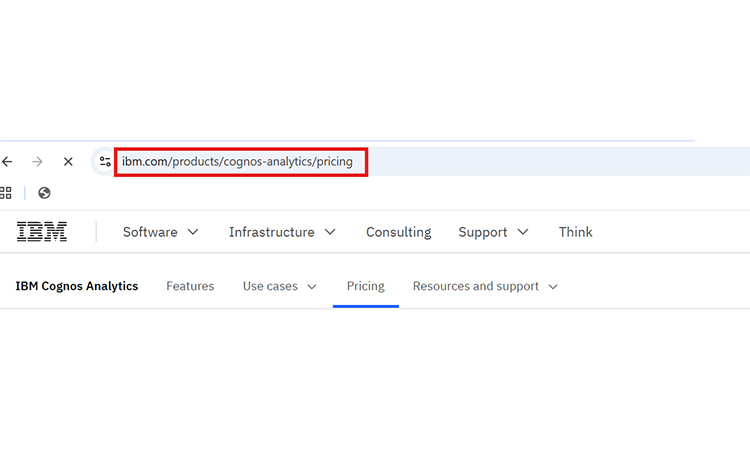
The example of a right URL is https://www.example.com/products/cognos-analytics instead of https://www.example.com/page?id=123&ref=products=cognos.
- Image Optimization
A large number of tech websites use UI screenshots, diagrams, architecture visuals, dashboards, and product mockups. If you also do the same, you need to optimize your images well. Otherwise, you miss the opportunity for benefits like page speed and search visibility.
Top Practices to Consider for Image Optimization
You need to take into account the following crucial practices for image optimization. Let’s explore them one-by-one:
- You should use keyword-relevant alt text.
- Make sure the file names are descriptive.
- Use descriptive file names.
- Always use modern file formats (WebP)
- Compress images for quick loading.
- Add structured data where relevant.
3. Perform Technical SEO
Technical SEO is often overlooked, though it keeps a much importance for search engine optimization. You should do it, in fact, before starting the actual SEO activities. If you fail to do it properly, your website will fail to generate more leads, no matter how much traffic it generates.
A large number of visitors come to your website through search engine optimization. So, to convert them into potential customers, your website should offer an outstanding user experience to ensure it stays longer and thus engages more with your content.
Technical SEO for tech companies determines how quickly your web page loads. It also ensures whether meta title or description matches the actual information of your pages. It reflects the search engine bots get a capability of finding, crawling, and properly indexing your website.
- Important Areas to Focus on For Technical SEO
To do technical SEO better, you need to focus on several important areas. Some of them are as follows:
- Mobile Usability
We are familiar with Google’s preferences for mobile-first sites for SEO ranking. The reason is that smartphone users are growing by leaps and bounds. According to the latest data by Exploding Topics, the total number of smartphone users across the world is approximately 7 billion. And the majority of smartphone users browse their mobile phones to search for any services. Therefore, it’s necessary to check the mobile usability of your website and take the necessary action accordingly.
We have checked the mobile usability of IBM by using SE Ranking. And the final result appears as follows:
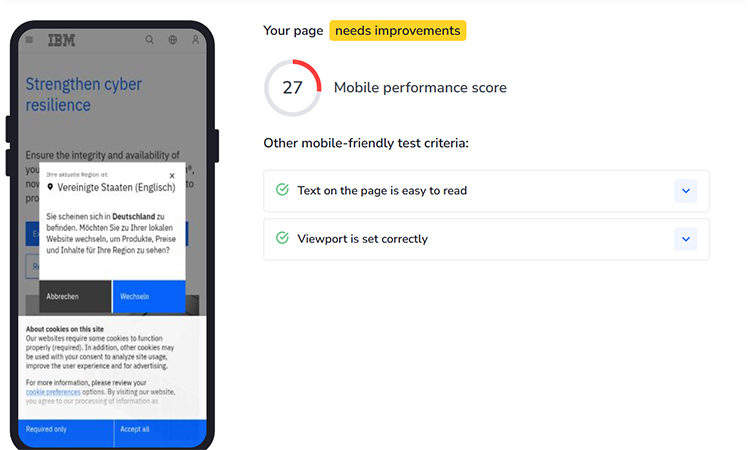
The above result clearly reflects that the website needs to be improved from a mobile usability point of view.
If your website also appears as the above, you need to take some important measures to improve mobile usability. Some of them are as follows:
- Use a mobile-responsive design.
- Make text easy to read.
- Include a simple form.
- Optimize navigation
- Page Speed and Core Web Vitals
When we talk about fast-loading pages, these not only boost user experience but are also a crucial ranking factor. You need to take into account that Google uses a complete set of metrics like Core Web Vitals to determine how users experience the responsiveness, speed, visual stability, etc., of your website.
To check the page speed of your website, we will leverage tools like PageSpeed Insights:
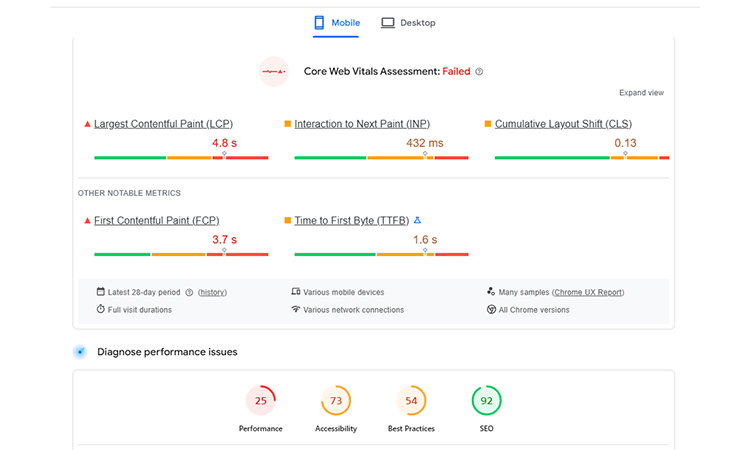
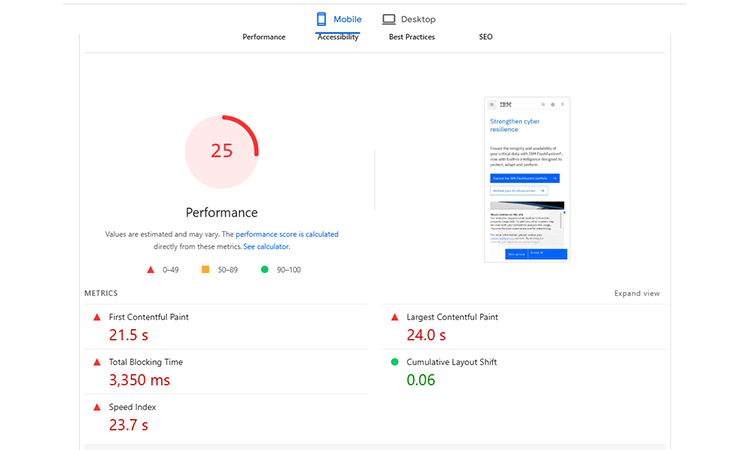
You can see that the above result is not satisfactory. If your website also appears the same, you need to take the following important steps to improve its loading speed:
- Compress and optimize images
- Enable browser caching
- Minify files
- Use a Content Delivery Network (CDN)
- Minimize third-party scripts
- Upgrade your hosting
- Crawling and Indexing
To ensure your page appears in SERPs, it should be easily accessible to search engine bots. You need to use the indexing report in Google Search Console to check whether important pages of your website are being processed.
The most important thing you need to keep in mind is that technical SEO is not one time. It’s an ongoing process that helps you in optimizing your website to allow your visitors to get the best browsing experience and ensures your pages are reachable and indexed by search engines.
4. Use White-Hat Link Building Strategies
As one of the core off-page SEO strategies, Backlinks are one of the top ranking factors in search engine optimization and also in the tech industries. So, you need to focus more on effective methods that help you create backlinks.
The first and most important place to start is with platforms that have authority in your space. You can find them easily with a Google search. It’s also crucial to consider where your potential customers may look for tools, software, or partners. The following are some of the top opportunities to think:
- Niche Directories
Niche directories are basically marketplaces, such as cloud partner directories, StackShare, or platforms where developers get a possibility to compare software. They send powerful signals and also stay online for several years.
- Clutch and Other B2B Platforms
These are important platforms that are quite beneficial for both credibility and visibility. A large number of buyers often check them even before they reach out, and every listing also offers you an important backlink.
- Guest Blogging
Guest blogging is one of the most reliable and practiced ways of gaining quick links from reputable sources. You need to craft blogs as an expert. Make sure it’s informative and compelling for users. It should offer hands-on advice or case-based details that users can learn from.
- Go for Advanced Link Building
Once you are aware of the actual sources of earning backlinks. You need to go a step further and explore link-building opportunities for tech-related websites, which will definitely help you in generating quality links for your website.
- You can get listed in those blogs that review various tools. These blogs tend to rank quickly with high-intent keywords.
- The next thing you can do is to find and claim those unlinked brand mentions. In some cases, people may be talking about your organization online, and you can surface those mentions with the help of a reliable online reputation management tool.
- You can also share expert input for the interview pieces. You will come across many blogs that feature experts on industry trends. They constantly look for some new voices as well.
- Use The Power of Your Internal Links
While talking about link building, it’s impossible to forget the potential of internal linking. When you use it with the right strategy, it helps you distribute authority across your pages, move from a particular topic to the next, and keep users engaged for a long time.
Internal links are also useful for Google to understand the structure of your website better. They reflect the relation of the linked pages and also which page deserves more attention.
Internal links keep great importance when it comes to SEO for tech companies. Let’s explore some of the vital practices you can consider implementing:
- You should always link from your high-traffic pages, including guides or blog posts. And then put it on your commercial pages.
- Don’t forget to write some meaningful and descriptive anchor text that indicates the target page.
- You need to refresh your old posts by linking to your latest content.
5. Local SEO for Tech Companies
Do you target clients locally for your tech company? If yes, then you can’t ignore the importance of local SEO efforts. It allows your software development company to focus on clients in your nearby geographical locations. Optimizing local search lets your organization appear in SERPs when potential clients look for software services nearby.
- Vital Local SEO Tactics
The following are some of the top local SEO techniques you need to consider to implement. Let’s go through each of them:
- Create Google My Business
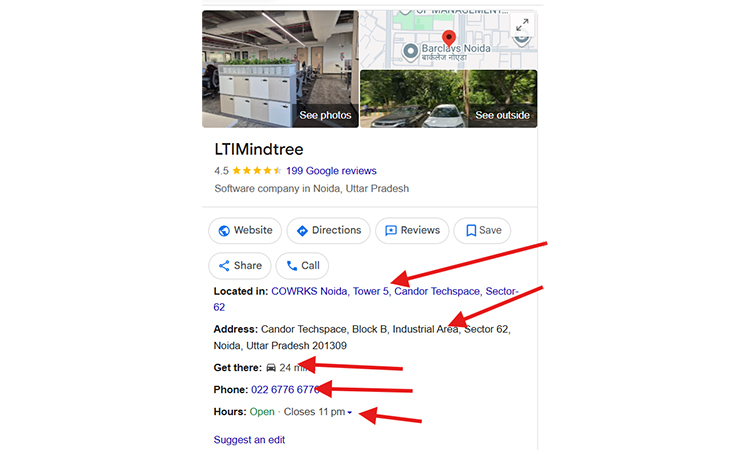
While talking about local SEO for tech companies, it’s good to start by creating Google My Business (GMB). You need to first set up your GMB profile by adding your business details with accuracy. It should include the following details:
- Business name
- Location
- Hours of operations
- Services
- Contact details
You need to update the information regularly by including posts, images, and client reviews.
- Use Location-based Keywords
The next thing you need to do is to target keywords that are location based, which are also termed geographic modifiers. If your company deals in software development and you wish to target Las Vegas, you can use keywords like software development company in Las Vegas.
- Include Client Reviews
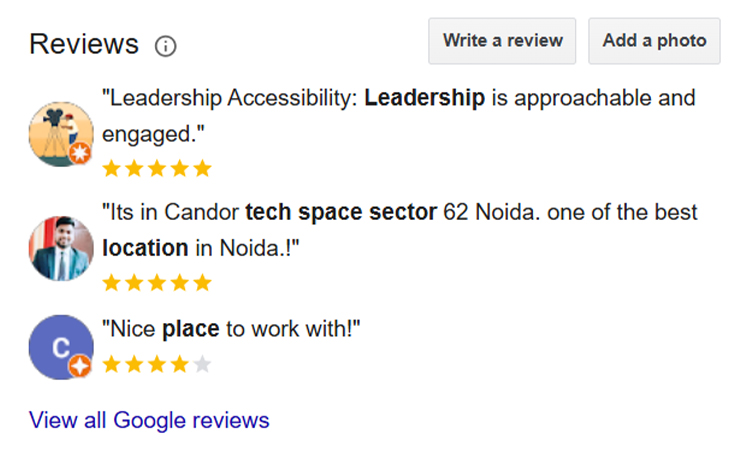
The fact can’t be denied that reviews encourage your potential clients to buy your products or services. Make sure your GBP includes genuine reviews from your past or current clients. To get more reviews, you need to encourage your satisfied clients and approach them constantly to write and leave reviews. It really works.
6. Do Content Marketing with a Proven Strategy
Effective content marketing plays an intermediary role between your expertise and the target audience’s requirements. Unlike generic campaigns, technical audiences demand precision. Every resource should have the capability to resolve issues while matching search engine requirements. It’s advisable to start the process by determining queries to any specific objectives, be it guiding C-suite decisions or educating developers.
- Plan Content According to Search Intent
Technical searches reflect clear patterns. For instance, the majority of IT professionals seek to have complete tutorials over overviews. These insights you can use to categorize the type of content easily.
You need to align articles with user intent, as it helps you minimize bounce rates.
- Create a Dynamic Editorial Calendar and Implement Properly
You need to plan everything carefully about what to post and also their frequency. And for its better implementation, you need to create an editorial calendar. The next thing you can do is to assemble your team that combines designers and technical writers. You can make a perfect balance of evergreen guides with on-time updates, including covering new API standards within weeks of release. You need to focus on channels where your audience engages easily.
- You should always focus on YouTube for a complete visual demonstration.
- You can use developer forums for niche-specific tutorials.
- You need to make podcasts that should be focused on industry trends.
It’s advisable to analyze content performance with engagement metrics. Besides this, you need to also adjust your calendar quarterly to shift your content strategies.
7. Track Analytics to Analyze Results
Keeping an eye on the analytics is necessary to determine the overall impact of SEO for tech companies efforts for tech service providers. To do it easily, you can utilize reliable tools like Google Analytics and Google Search Console. These tools help you analyze important metrics that give you insight into the actual SEO performance of your campaign. Based on your overview, you can adjust your campaign accordingly to gain the desired outcomes.
What are the Metrics to Track to Analyze Results?
So, you already may be thinking about which metrics to analyze, right? Well, we will provide you with a list of all those metrics you need to focus on. Some of them are as follows:
- Traffic growth
- Keyword position improvement
- SERP volatility
- Form submission
- Contact inquiries
- Bounce rate
- Time spent on the page
- Competitor improvement
Common SEO Mistakes for Tech Companies to Avoid
SEO can be a powerful strategy for your technology companies only when you do it right and avoid some mistakes. We will discuss some of the common SEO mistakes you need to avoid to get outstanding outcomes:
- Avoiding Search Intent
Most technology companies often avoid search intent while doing search engine optimization. And this is the biggest mistake you need to avoid. Even if your website ranks for particular keywords, it will be futile when your content fails to match what users search for.
When you target high-volume terms even without getting information regarding whether users seek comparison, information, or a solution causes a higher bounce rate and fewer conversions. Make sure your SEO for tech companies strategy aligns keywords better with user intent at every important stage when it comes to the buyer’s journey.
- Focus Only On Product Pages
A large number of tech companies rely extensively on feature or product pages and avoid information content. Though product pages are crucial, they don’t grab early-stage prospects.
Be it use cases, blogs, thought leadership content, or comparison guides, it’s useful to educate users to develop trust and lure organic traffic even before buyers are all set to convert.
- Avoiding Content Updates
Tech companies often publish content and forget it. If you also do the same, it’s indeed the biggest mistake you commit. Not to forget, search engines always prefer relevant, fresh, and updated content. Make sure you remove broken links, outdated statistics, obsolete features, etc.
These impact on the ranking and credibility of your business. You need to update your blogs, documentation, and landing page regularly. It helps you in maintaining relevance and thus enhances search performance over time.
- Poor Interior Linking Structure
If you have an ineffective internal linking structure, it creates difficulties for both users and search engines to understand and navigate your website. Make sure your website has proper links between valuable content and related pages. You need to know that strategic linking is required to boost crawlability, boost user experience, and distribute and link equity for a content-heavy and large website.
- Improper Alignment of SEO with Business Goal
Your SEO for tech companies’ efforts will be futile, especially when you do it in isolation. If you drive traffic without considering conversions, lead quality, and revenue, it impacts adversely on ROI. Therefore, you need to ensure that your search engine optimization strategies align better with your core business objectives, like customer acquisition, market expansion, retention, etc., to offer measurable outcomes.
Future SEO Trends for Tech Companies
Search is evolving with the continuously changing user behavior, intent, and many other factors. So, it’s necessary for you to keep an eye on the evolving SEO trends and implement them with the right strategy. The following are some of those trends:
- AI-based Search Results
Be it AI summaries and generative search results, many AI-based search experiences redefine visibility in SERPs. Search engines now focus more on authority, context, and usefulness, especially when compared to keyword density.
It reflects creating expert-led and in-depth content that answers queries with clarity for a large number of tech companies. Be it strong topical authority, structured data, or trustworthy and high-quality content, it will be important to be surfaced or cited in AI-based outcomes.
- Search Intent over Keywords
The future of SEO for technology companies is going to be more focused on intent instead of keywords. So, you should not waste your time on targeting only keywords. You need to also get information regarding the user’s intent, whether it’s navigation, information, transactional, or commercial.
Once you are aware of why and what your target audience searches for, it helps you create high-quality content that solves most of their queries, and thus helps them in making their buying decision easily. This is indeed a great trend that boosts customer engagement, conversion, and also the ranking of your website in the long term.
- Multimodal Search Optimization
Search is evolving to a great extent and is not limited only to text. Users nowadays search in several ways using images, voice, videos, and screenshots. Multimodal search optimization needs a tech company to optimize video content, visual assets, and audio experience alongside traditional web pages. Be it video transcripts, image alt text, mobile-friendly design, or schema markup, they play a lead role in discoverability across a range of search formats.
- Data-led Personalization
When it comes to personalized search experience, it has become quite common since search engines leverage location, user behavior, preferences, etc. You need to leverage CRM insights, data analytics, user behavior, and more to create a personalized user journey.
Whether it’s dynamic content, tailored landing pages, or intent-focused recommendations, they improve engagement, relevance, and conversion rate. It supports the overall search engine optimization performance.
- Crawl Budget Optimization
Crawl budget optimization is in vogue nowadays, especially when tech websites grow with complex APIs, complex architectures, and dynamic pages. If a website has an inefficient site structure, search engines will be unable to crawl it. And we are aware of the fact that search engines allocate only limited crawling resources.
So, if you maximize the probability of crawlability and rankings of your web pages by search engines, you need to remove duplicate pages, optimize crawl paths, and improve internal linking.
Partner with a Professional SEO Agency for Tech Companies
A proper SEO of a tech company involves formulating a lot of research, planning, strategizing, promotion, etc. And this is something you can expect from only a professional SEO company. Make sure your service provider possesses vast domain expertise and helps you reach your target audience at the right time.
- Benefits of Hiring
A genuine and professional SEO agency possesses vast expertise when it comes to handling SaaS platforms, complex tech products, and B2B sales cycles. Let’s explore some other advantages of hiring them:
- A leading SEO agency brings in-depth expertise to manage SaaS platforms, complex tech products, and B2B sales cycles.
- They have a vast understanding of technical SEO elements such as page speeds, site architecture, API-driven websites, and schema markup.
- They perform keyword research and target high-intent search queries that lure qualified leads rather than only traffic.
- They are versed in emerging search engine algorithms and various industry trends. It ensures your strategy remains future-proof. From content optimization to conversion rate optimization (CRO), they help your in-house team to emphasize innovation and product development.
- They offer measurable outcomes through performance tracking and transparent reporting.
- Things to Look for While Hiring Them
It goes without saying that hiring a genuine SEO agency is a responsible task that involves a lot of research work. It’s indeed a time-consuming process. We help you handle it easily by explaining the following tips and tricks:
- Check their previous experience. Make sure your selected service provider possesses adequate experience in similar industries. You need to go through their client testimonials, case studies, success metrics, and more to determine real-world outcomes.
- You should also not forget to check the technical expertise of your selected SEO agency. Make sure they have the capability of handling website migrations, advanced audits, and complex integrations.
- Don’t forget to analyze their reporting approach and communication style. A reliable agency should provide realistic expectations, clear timelines, and regular performance updates.
- Don’t even think about hiring those who make false promises like instant ranking. Instead, you can consider hiring those who focus on long-term and sustainable growth aligned with your key business objectives.
FAQs
Ans. The major advantages of SEO for tech companies include attracting high-intent traffic, propelling online visibility, generating qualified leads, building brand credibility, and achieving sustainable growth. These indeed minimize long-term customer acquisition costs in the fast-growing and emerging digital markets.
Ans. Well, there are many SEO tools available for tech companies. These include SEMrush, Ahrefs, Google Search Console, Moz Pro, and Screaming Frog. They are useful in tracking the performance of the SEO campaign.
Ans. Tech companies can use several tools for keyword research, such as SEMrush, Ahrefs, AnswerThePublic, Google Keyword Planner, and many others. They are useful in discovering long-tail and intent-driven keywords in technical niches.
Ans. Tech startups can boost their website ranking by focusing on powerful technical SEO, mobile optimization, fast page speeds, quality keyword-driven content, authoritative backlinks, and more.
Ans. An average cost for search engine optimization for any tech company starts from $500 and can go up to $3000 or even more than this. It also depends on many important factors such as goals, competition, content creation, technical SEO, tools used, and more.
Ans. SEO for any tech company mainly emphasizes complex buyer journeys, technical accuracy, high-intent keywords, etc. It focuses on product-led content, thought leadership, trust building, and technical SEO.
Ans. SEO results for tech companies may take 3 to 6 months. Its timeline also varies based on other factors such as keyword difficulty, competition, technical SEO, content quality, consistent optimization efforts, and more.
Conclusion
So, you have understood the actual importance of SEO for tech companies, right? Search engine optimization helps your business create an authoritative and competitive web presence to boost your lead capture potential and develop brand reputation. It helps your businesses get a full understanding of your customers’ requirements and desires, and thus allows you to move with their continuously changing preferences over time. It helps you in maintaining a successful website in a constantly evolving and updating world.
So, it’s the right time to proceed to chalk out the right SEO strategies for your tech business and ensure its proper implementation. Partnering with a top-notch service provider will help you do all these better and get the desired outcomes.

